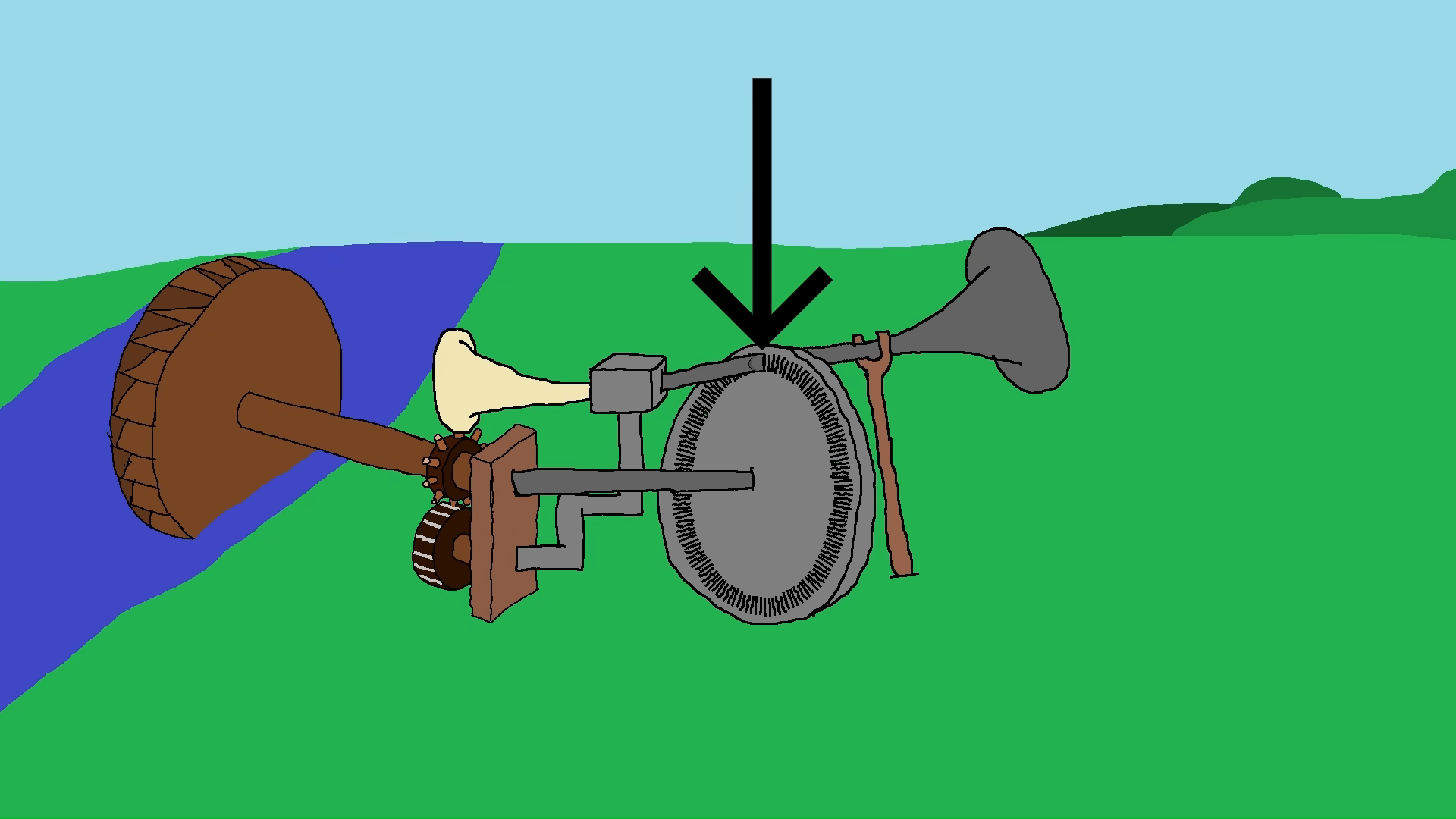
Have you ever wondered what human ingenuity could achieve if electronics had never entered the chat? Personally, I think we radically underestimate the sheer mechanical brilliance of our ancestors, assuming that sophisticated communication requires silicon and microchips. One thing that immediately stands out when exploring alternative engineering histories is how close ancient civilizations actually were to inventing concepts we consider thoroughly modern. If you take a step back and think about it, the foundational logic of broadcasting—compressing energy, imposing a carrier wave, and modulating a signal—doesn't strictly depend on electromagnetic fields. What makes this particularly fascinating is the proposition that ancient engineers, like those in Hellenistic Greece, possessed all the raw mechanical prerequisites to build a fully functional, zero-electricity radio system using little more than waterwheels, slotted disks, and pneumatic pressure chambers.
The Pneumatic Symphony: Rewriting the Rules of Signal Generation
When most people think of a radio, they picture invisible electromagnetic waves whispering through the ether, captured by invisible antennas. But what many people don't realize is that sound is fundamentally just pressure waves traveling through a medium—and media like air can be manipulated with purely mechanical leverage. To build an acoustic radio without a single transistor, you need a steady carrier frequency, which modern electronics achieve via quartz oscillators. In a mechanical setup, however, you can achieve the exact same effect by forcing compressed air—generated by an ancient waterwheel—through a rapidly spinning slotted disk.
In my opinion, this approach bridges a conceptual gap that highlights how much our modern perspective is blinded by our own tech stack. A rotating disk chopping an air stream into discrete pulses at ten thousand hertz is essentially a mechanical oscillator. It forces a physical medium to behave with rhythmic, predictable regularity. What this really suggests is that information theory precedes the materials we use to execute it. The universe doesn't care whether your carrier wave is measured in gigahertz of electrical current or mechanical vibrations screaming through a brass pipe; the math of modulation remains brutally consistent.
The Art of Mechanical Modulation and Demodulation
Of course, generating a carrier wave is only half the battle; you also have to imprint human speech onto it, which is where things get brilliantly eccentric. In an electronic AM radio, a varying voltage alters the height of the carrier wave. In an air-powered mechanical radio, you substitute voltage changes for physical air pressure fluctuations by linking a vocal diaphragm directly to a conical valve. As you speak, your breath opens and closes this valve, amplitude-modulating the pneumatic stream before it travels across space through a giant gramophone horn.
What I find especially interesting is the demodulation process on the receiving end, which operates entirely without an external power source. By utilizing a precisely measured acoustic tube that acts as a physical filter—bouncing the ten thousand hertz carrier wave to amplify its force while canceling out ambient noise—and passing it through a tiny flap valve and micro-chamber, the compressed air pulses blend back into a smooth, intelligible voice. If you had a trombone-like sliding mechanism on that tube, you would essentially be tuning your mechanical radio dial across different pneumatic frequencies. It is a wonderfully poetic piece of engineering that forces us to reconsider the boundaries of what 'technology' actually means.
The Brutal Realities of Pre-Industrial Broadcasting
Before we get too carried away imagining ancient philosophers broadcasting poetry across the Athenian hills via pneumatic horns, we have to confront the messy physics of the real world. Personally, I suspect that listening to a mechanical air-radio would be an exercise in extreme auditory patience. Air is a notoriously stubborn and inefficient transmitter of energy; acoustic waves lose momentum rapidly to heat friction, meaning your absolute maximum broadcast range would likely hover around a single kilometer under ideal conditions.
Furthermore, the environmental vulnerability of a pneumatic system is staggering compared to radio frequencies that pass straight through walls and bad weather. A sudden gust of wind, a passing rainstorm, or even a local temperature shift would instantly distort or completely obliterate the acoustic carrier wave. This raises a deeper question about technological evolution: why certain paths are abandoned while others dominate. It wasn't just a lack of imagination that stopped the Greeks from building a mechanical radio network; it was the sheer, suffocating limitation of working with physical fluids instead of fields. Yet, despite the scratchy, tin-can sound quality reminiscent of Thomas Edison’s earliest phonographs, the sheer conceptual audacity of piping voice signals across a valley with water power and air pressure is something that deserves our unending admiration. Check out the conceptual breakdown in the video about how Ancient Greeks Could've Made a Mechanical Radio [00:00:00].